When Growth Outpaces Support
Signs Your MSP Can’t Scale With Your Business
JOE INFANTE

There’s nothing more exhilarating in business than experiencing strong growth. New contracts, expanded teams, and fresh market opportunities bring both excitement and organizational transformation. But rapid scaling isn’t just a victory, it presents a host of new challenges, especially when it comes to technology. One critical partner on this journey is your Managed Services Provider (MSP). And if your organization is between $20–$250 million in revenue, the right MSP can be the difference between uninterrupted progress and complete operational gridlock.
But what happens when your MSP simply can’t keep up?
Growing Pains: Warning Signs Your MSP is No Longer the Right Fit
The reality is that many MSPs are structured to serve companies with relatively stable environments and predictable technological needs. As your business grows and complexity increases, the cracks in this arrangement can suddenly become gaping holes.
Here are the most common symptoms experienced by organizations where growth has outpaced the MSP:
Slow Onboarding & Delayed Access
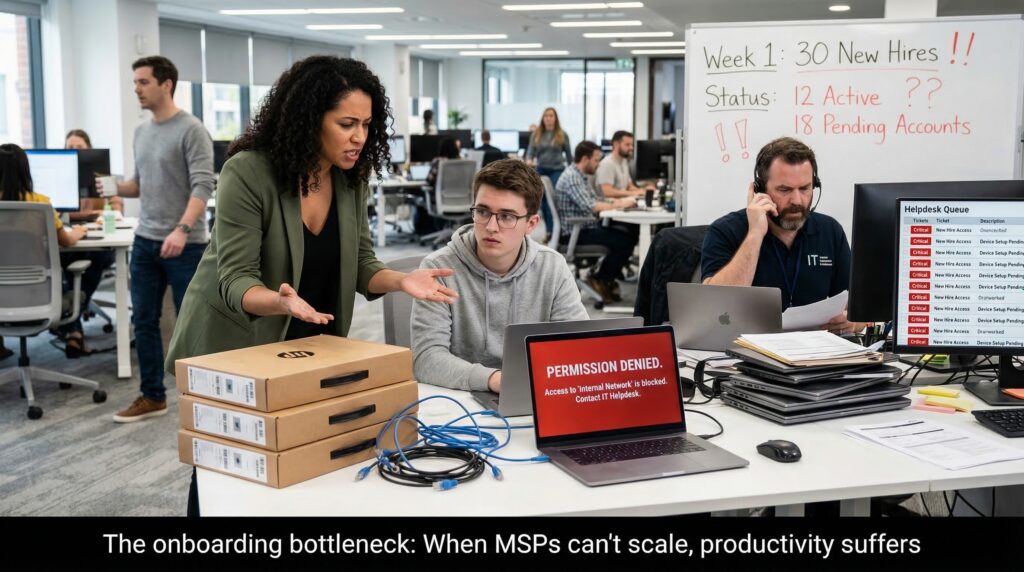
As new employees join the company in droves, there’s an expectation that accounts, devices, and permissions will be ready on day one. When these processes lag, productivity suffers and data security may be compromised. Often, MSPs without scalable onboarding systems can’t keep up with the speed of hiring, leaving teams frustrated by access issues and helpdesk backlogs.
Unmanaged Remote Teams and New Sites
Expanding sales regions, new branches, or a sudden shift to remote work are the norm for a rapidly growing business. However, if your MSP struggles to extend secure, standardized IT support to these new environments, your business faces inconsistent service quality, unmanaged endpoints, and increased chances of costly errors or breaches.
Insufficient Backup and Disaster Recovery

Shadow IT and Fragmented Support
Moving fast often means departments and end-users find their own solutions, be it SaaS, cloud storage, or collaboration apps. Without a scalable MSP strategy, these unsanctioned tools proliferate, falling outside official oversight. The result? An IT environment that is fragmented, harder to secure, and almost impossible for your current provider to support holistically.
Reactive, Not Proactive
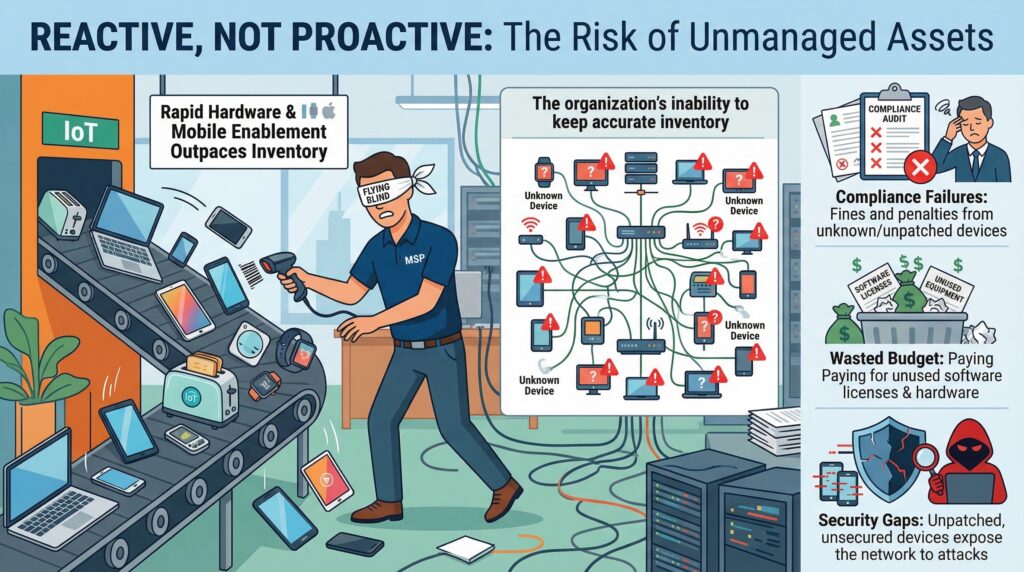
Rapid hardware purchases, new device types, and mobile enablement outpace the organization’s ability to keep accurate inventory. Your MSP is left “flying blind,” unable to support, update, or secure what they don’t know exists. This exposes your organization to compliance failures, unnecessary expenses (unused licenses or equipment), and unchecked vulnerabilities.
Underpowered Security
As user counts, endpoints, and data volumes go up, so do attack vectors. If security controls, monitoring, and incident response don’t scale at the same pace, gaps will expand. An outgrown MSP may be able to patch the basics, but not offer the layered protection needed for larger organizations, leaving you more exposed to breaches and regulatory penalties.
Change Management Breakdown
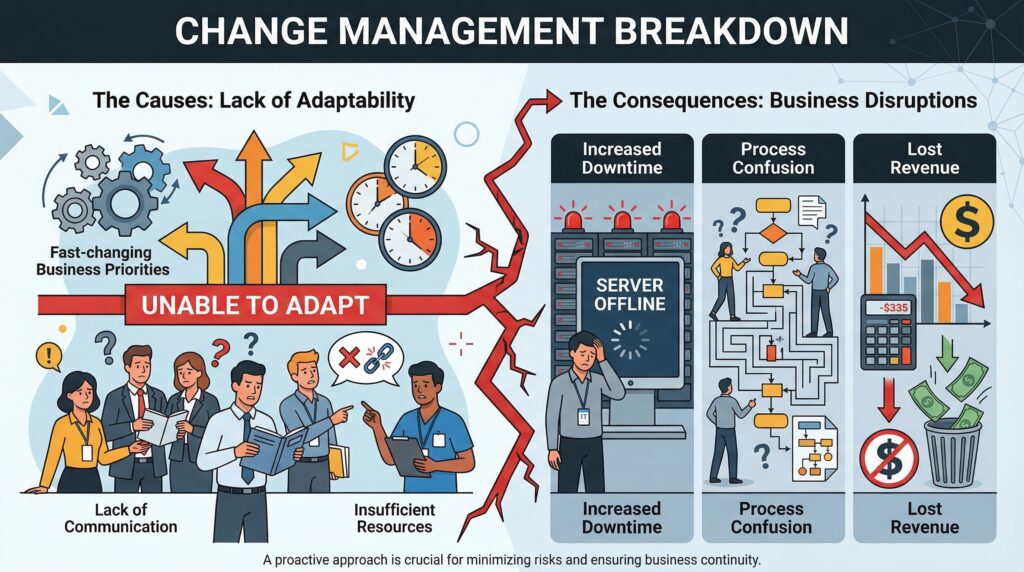
Fast-changing business priorities and workflows require robust change management. If your MSP can’t adapt to continual process tweaks—because they weren’t informed or lack resources—business disruptions multiply. Misaligned changes result in downtime, process confusion, and lost revenue.
Outdated SLAs & Stretched Resources
What once was prompt service now becomes delays, finger-pointing, and missed service level agreements (SLAs). Your MSP’s team and tools may be perfectly suited for a smaller, more predictable environment, but they’re now stretched thin, leading to increased wait times, unresolved issues, and employee frustration.
Sprawling Technology Stack
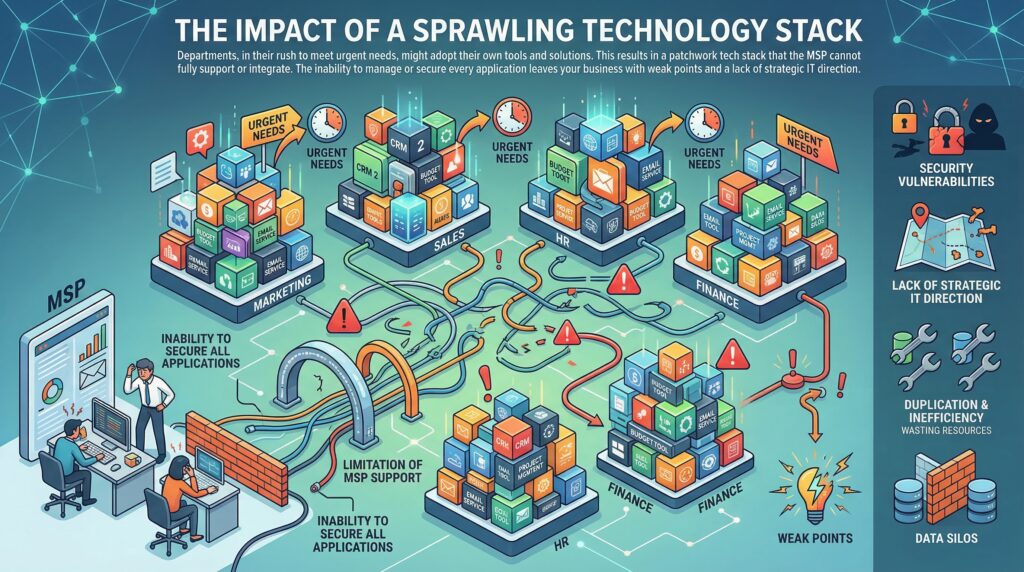
Departments, in their rush to meet urgent needs, might adopt their own tools and solutions. This results in a patchwork tech stack that the MSP cannot fully support or integrate. The inability to manage or secure every application leaves your business with weak points and a lack of strategic IT direction.
Why It Happens: The Dangers of Outgrowing Your MSP
MSPs, like the businesses they serve, have a sweet spot. Some are built for small businesses or steady-state environments with predictable challenges. Others have invested in tools, talent, and processes to support scaling organizations, dynamic, multi-location, regulated, or global. The mismatch happens when a company’s needs blow past what an MSP’s platform or service model can deliver.
MSP problems during scale-up often stem from:
- Rigid service catalogs that don’t flex to new demands.
- Minimal investment in automation for onboarding, offboarding, and asset management.
- Lack of strategic IT advisory services, resulting in more reactive than proactive guidance.
- Shortage of security staff and evolving compliance knowledge.
- Underinvestment in advanced monitoring, reporting, and integration tools.
The Organizational Side: Making Growth Even Harder
While much responsibility falls on the MSP, scaling organizations often contribute to these issues:
- Fast expansion without IT planning means the MSP is always behind the curve.
- Departments introducing new technology without coordination create support and security blind spots.
- Untracked assets and minimal documentation result in troubleshooting delays and wasted resources.
- Unrealistic expectations that IT services, and the MSP, will instantly scale up without added investment.
Growth is exciting. But without the right foundation and a partner that can keep pace, it can turn agile companies into chaotic ones, putting operations, data, and reputation at risk.
When Is It Time to Move On?
If these symptoms are familiar, it may signal that your current MSP is no longer suited for your organization’s size and speed. Watch for:
- Consistent service delays and missed SLAs.
- Difficulty getting clear answers from your provider about how they’ll adapt to your new needs.
- Recurring issues with new sites, users, or technology platforms.
- Security or compliance lapses identified in audits or after incidents.
- Increasing numbers of “out of scope” invoices for basic operational needs.
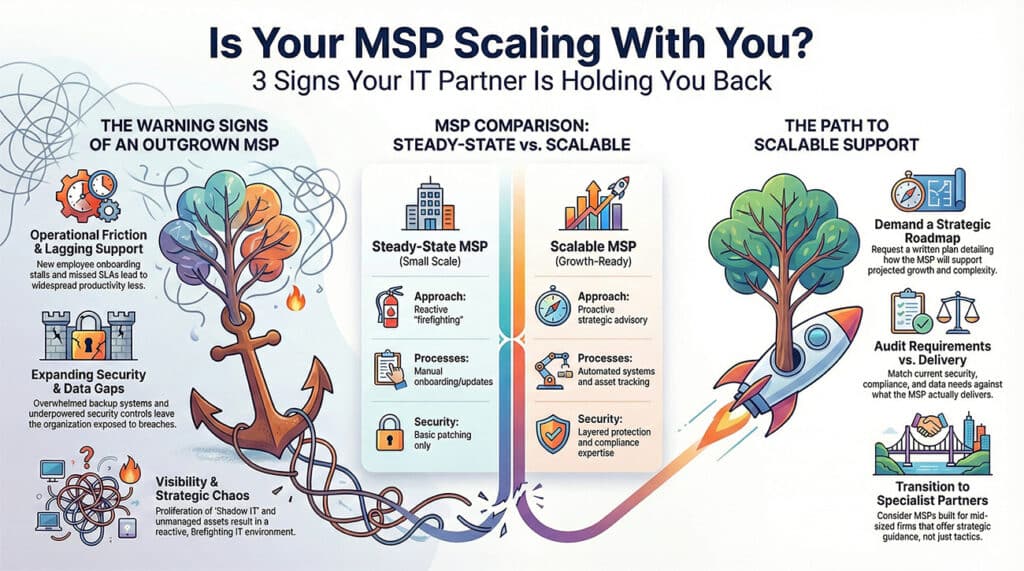
What To Do Next
- Assess and Prioritize:
Audit your current and future IT requirements, employee growth, locations, data, security, compliance, and match against what the MSP actually delivers. - Demand a Roadmap:
Ask your MSP for a written plan on how they will support your projected scale. If the answers are vague, it’s a strong warning sign. - Re-evaluate SLAs & Capabilities:
Update expectations, demand transparency, and get clarity on escalation, coverage, and expansion support, including onboarding, security, and backup capacity. - Consider Specialist or Tiered MSPs:
Providers built for midsize or fast-growing organizations will have the structure, talent, and processes to keep you moving forward, often with strategic, not just tactical, guidance. - Create Better Internal Alignment:
Formally align your IT strategy with business growth, including clear change management, asset tracking, and cross-department coordination.
Rapid growth is an achievement to celebrate, but it shouldn’t come at the expense of operational stability or security. Your MSP should be a true partner—scalable, strategic, and invested in your trajectory. If you’re leaving them behind, it may be time for both of you to graduate to the next stage.
Is your MSP keeping up with your growth, or are you outpacing their ability to support your ambitions? Let’s talk about how to ensure your technology drives, not drags, your success.

Compass Left
We are dedicated to providing expert business technology management services and offer unparalleled independence. Our focus is to understand your business, apply our knowledge, experience and relationships to ensure the most efficient alignment between technology and your business objectives. Offering executive-level expertise, we engage across all business dimensions, from HR to finance and operations, to ensure technology serves as a backbone for your strategic objectives.