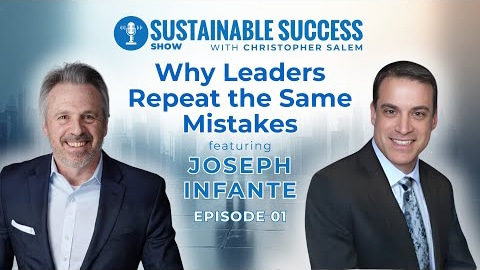
The Sustainable Success Show
JOE INFANTE & CHRISTOPHER SALEM

As we settle into 2026, many leaders are already looking at their strategic initiatives and wondering why they feel stuck in the same loops as last year.
Uncovering the Hidden Patterns That Stall Growth
WHAT YOU WILL LEARN
Move Beyond Hero Mode: Leaders must recognize when to step back from “hero mode” and delegate operational tasks, as constant intervention prevents the organization from maturing and scaling effectively.
Prioritize Process Over Tools: Organizations should avoid “tool-first thinking” because implementing new technology without first fixing broken internal processes will only amplify existing inefficiencies rather than resolve them.
Establish Internal Alignment First: Before engaging external vendors or starting complex projects, leadership teams must achieve internal alignment on core workflows, such as the lead-to-cash process, to ensure successful execution.
Below is a Summary of the conversation between Joe Infante of Compass Left and Christopher Salem from The Sustainable Success Show. If you would like to watch the interview click HERE: Joe Infante and Christophe Salem
It is a common frustration: despite experience and awareness, leaders and organizations often repeat the same mistakes, unable to break through to the next level of scale. The issue is rarely a lack of effort; rather, it is often driven by unconscious behaviors and hidden patterns that influence results in both business and life. Awareness alone is not enough to change these behaviors; we must actively identify and dismantle the patterns keeping us stuck.
One of the most prevalent patterns we see in scaling organizations is what I call “Hero Mode”. This occurs when a business owner or executive—who was instrumental in the early days—continues to jump into operations to “save the day” long after they should have delegated those tasks. While well-intentioned, this inability to let go stifles the organization’s maturity, preventing the team from developing their own methods for success. Leaders must recognize when their involvement shifts from being a necessity to becoming a bottleneck, and understand that the team may execute differently, but still effectively.
Another pattern that plagues growing companies is a cultural addiction to “firefighting”. Many organizations are excellent at reacting to crises—they rally the troops and solve the immediate problem with high energy—but they struggle to function effectively when things are calm. This reactivity is often a symptom of poor alignment or a lack of defined processes. When a company is better at chaos than consistency, it indicates that the foundation needed for sustainable scaling is missing, leaving the team constantly reacting rather than strategically executing.
In an attempt to fix these operational inefficiencies, leaders often fall into the trap of “tool-first thinking”. This is the mistaken belief that buying a new software system or technology platform will magically resolve deep-seated process issues. As a technologist, I see this constantly: companies implement expensive tools hoping for a quick fix, only to find that the technology merely amplifies the existing broken processes. Technology cannot fix a process problem; it can only accelerate it. Before worrying about vendors or demos, organizations must look inward to understand their people and workflows.
Leaders also struggle with the difficult reality of trade-offs. It is common to start the year with dozens of initiatives, only to look back and realize that few were completed effectively. There is a finite limit to what can be achieved with available time, budget, and personnel—the classic triangle of “fast, cheap, and good”. Trying to do everything often results in doing nothing well. Success requires the discipline to prioritize and the courage to accept that some manual processes may need to remain for a while so that the most critical automated initiatives can succeed.
The path out of these patterns begins with internal alignment, specifically by examining the “lead-to-cash” process. Before engaging with external vendors or seeking complex solutions, the leadership team must agree on what is actually happening internally, from the moment a lead comes in to when cash lands in the bank. This does not require a massive consulting study, but rather a high-level agreement on the people, systems, and general processes involved. When sales, finance, and operations understand the downstream impact of their actions—like how a missing billing address in the CRM delays a robust ERP implementation—the friction begins to disappear.
Ultimately, breaking these cycles requires intentional communication and a focus on execution over simple strategy. At Compass Left, we help leaders navigate these complexities by acting as a fractional CIO and project partner, ensuring that technology initiatives are aligned with business goals long before a demo ever takes place. Whether you are looking to correct a stalled ERP project or simply want to stop repeating the mistakes of the past, the key is to stop rushing and start aligning.
By addressing the root causes rather than just the symptoms, you can turn 2026 into a year of sustainable, scalable success.

Compass Left
We are dedicated to providing expert business technology management services and offer unparalleled independence. Our focus is to understand your business, apply our knowledge, experience and relationships to ensure the most efficient alignment between technology and your business objectives. Offering executive-level expertise, we engage across all business dimensions, from HR to finance and operations, to ensure technology serves as a backbone for your strategic objectives.