Why Your IT Executive Hire Will Probably Fail
And What To Do About It
JOE INFANTE

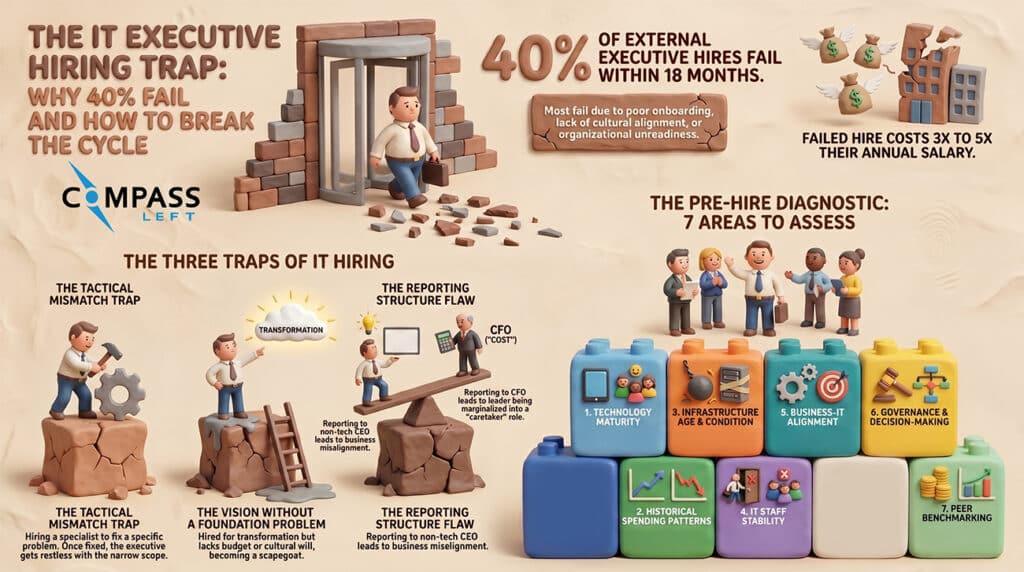
Every few years, the pattern repeats itself. A company decides it needs serious technology leadership. They recruit aggressively, pay a premium, and bring in someone impressive. Eighteen months later, that person is gone and the organization is back to square one, only now they are out thousands of dollars and further behind than when they started.
This isn’t bad luck. It’s a predictable outcome of a flawed process. And until organizations understand why these hires fail, they’ll keep making the same expensive mistakes.
If you want just the broad strokes of this IT EXEC HIRING TRAP – click play on our video below.
Why I Know This Pattern So Well
For over thirty years, I’ve observed IT hiring from a unique vantage point. I had direct experience, in my previous business, as a co-owner of a managed service provider (MSP). Also, our largest client was a large international chemical company, and I regularly consulted with their senior IT directors on internal recruitment strategies. What struck me most was how consistently they chased the wrong qualifications. In one particular case, they were obsessing over technical certifications for a position, like the MCSE (early two thousand), yet the real job demanded organizational acumen, the ability to manage across a globally distributed team, and to navigate stakeholders who couldn’t always accommodate immediate requests.
Here is another thing I know very well…
CEOs do not wake up thinking, “I need better business-IT alignment.”
At one point, a director challenged me when I insisted his job description was wrong. He basically said, “Put your money where your mouth is.” So, I offered right-to-hire placements under our company, with a six-month minimum billing period, after which the client could hire the resource permanently or continue the contract. We ended up placing resources throughout their enterprise for over fifteen years, with a conversion rate exceeding 90%.
These experiences, combined with decades of observing the same patterns repeated across organizations of every size and industry, became the foundation for both this article and the service practice we’ve built around solving it.

The Three Reasons IT Executive Hires Go Wrong
-
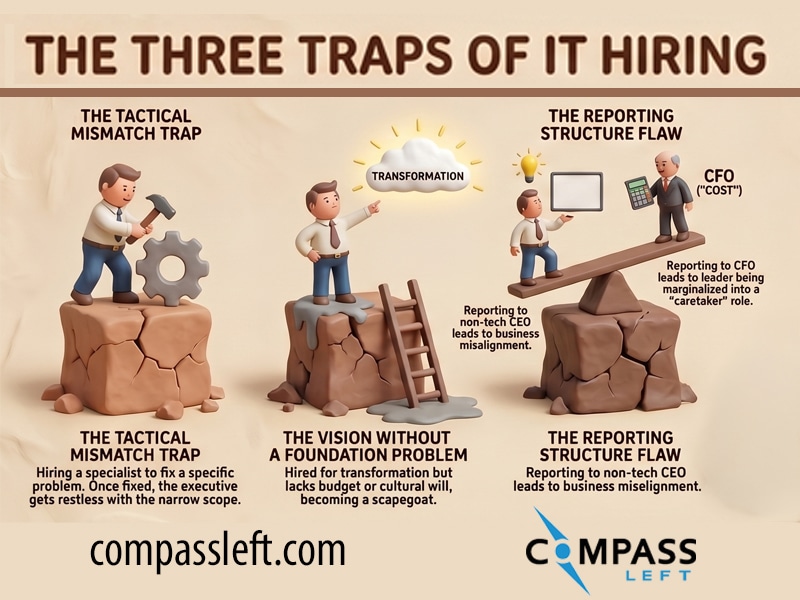
The Tactical Mismatch Trap
It usually starts with a specific pain point. Maybe the field service management system is a disaster. Maybe the ERP is out of date. The company identifies the problem, writes a job description around it, and hires someone with deep expertise in exactly that area.
The hire works, at first. The problem gets solved. But then what?
A talented resource who was brought in to fix one thing has now fixed it and may not be fit for the many other issues plaguing IT. There’s nothing left that genuinely challenges them. They get restless, disengage, and before you know it, they’re looking for their next opportunity. The organization is left wondering what went wrong, never realizing the job scope was simply too narrow from day one.
The issue was never the person’s skill level. It was the organization’s over-emphasis on a specific problem set, without regard to the needs of the position post-problem.
-
The Vision Without a Foundation Problem
This one is more dangerous, because it feels like ambition but functions like a trap.
An organization decides it wants to modernize, whether through digital transformation, AI adoption, or becoming a technology-driven company. Sometimes they know what’s broken and hire someone specifically to fix it. Either way, they bring in a CIO or IT director with a transformation mandate.
Two problems almost always follow.
First, the organization may not be as committed to transformation as the hiring conversation suggested. A change-minded executive arrives believing they have a genuine mandate. What they often discover is that the organization wanted the idea of transformation more than the reality of it. When change gets uncomfortable, budgets shrink, stakeholders retreat, and the executive who was hired to push forward gets labeled difficult for doing exactly that. This is compounded when the financial foundation simply isn’t there to support the vision. The mandate requires twice the budget that exists, the infrastructure isn’t ready, and rather than acknowledge the planning gap, the organization makes the executive the scapegoat.
Second, even when the commitment is genuine, fixing a broken technology foundation and running a mature operation are fundamentally different jobs requiring fundamentally different skill sets. The executive who thrives in transformation mode, energized by chaos and skilled at driving change, is often the wrong person to run the stable operation they just built. Organizations rarely plan for this transition, and the relationship breaks down not because anyone failed, but because the job quietly changed into something the executive was never right for.
-
The Reporting Structure Problem Nobody Talks About
Where your CIO sits in the organizational chart matters enormously and there’s no safe default.
Executive teams that lack technological literacy will typically lean heavily on the CIO for technology-related decisions, for example when the CIO reports directly to the CEO. Without adequate interaction and oversight, the organization runs the risk of IT becoming misaligned with business objectives. The business begins serving its technology instead of the other way around. IT budgets balloon, but the spending isn’t efficient or aligned with actual business needs.
On the other hand, if the CIO doesn’t report to the CEO, for example reporting to the CFO, which is not uncommon, and that CFO doesn’t deeply understand technology, the CIO gets quietly marginalized. Every budget request becomes a fight. Strategic initiatives get deprioritized because the finance lens sees cost, not value. The CIO becomes a caretaker rather than a leader.
Either scenario produces the same outcome: a talented executive operating in the wrong context, unable to deliver what the organization actually needs. And that’s the thread connecting all three of these problems. Whether it’s a scope that’s too narrow, an unrealistic commitment, or a reporting structure that sets the executive up to fail, the root cause is almost never the person. It’s an organization that hasn’t done the hard work of understanding what it actually needs, what it’s genuinely prepared to support, and what success realistically looks like before the hire is made.
The Numbers That Should Concern Every CEO
The evidence here is consistent across multiple independent sources and spans decades, which makes it harder to dismiss as an anomaly.
Research by Heidrick & Struggles, based on an analysis of 20,000 executive placements, found that 40% of senior executives hired from outside the organization are pushed out, fail, or quit within 18 months. The Center for Creative Leadership’s research corroborates this, placing the failure rate at 38% within the same timeframe. At the higher end, some broader analyses put the overall executive search failure rate somewhere between 50% and 70%, meaning the hire ends not just in departure, but in outright failure to deliver on the role.
These aren’t outlier studies. They represent a remarkably consistent finding across independent organizations researching the same question over multiple decades, and as recently as 2025, the 40% benchmark continues to be cited as an active industry reality, not a historical footnote.
The financial cost compounds the problem. A failed C-suite hire typically costs between three and five times the executive’s annual compensation, which accounts for salary and benefits during the underperformance period, recruiting fees, lost productivity, and opportunity cost. In cases with significant strategic consequences, that figure can climb as high as 27 times annual salary.
But perhaps the most important finding across all of this research is this: these executives don’t fail because they lack talent. They fail because of poor organizational fit, inadequate onboarding, and misalignment with the organization’s actual capabilities and culture. In other words, the organization is often more responsible for the failure than the executive.
The Real Problem Is What Happens Before the Hire
Most organizations treat IT executive hiring as a talent acquisition challenge. Find the best person, recruit them well, pay them competitively. But the evidence suggests the problem isn’t the talent, it’s the lack of organizational clarity that precedes the hire.
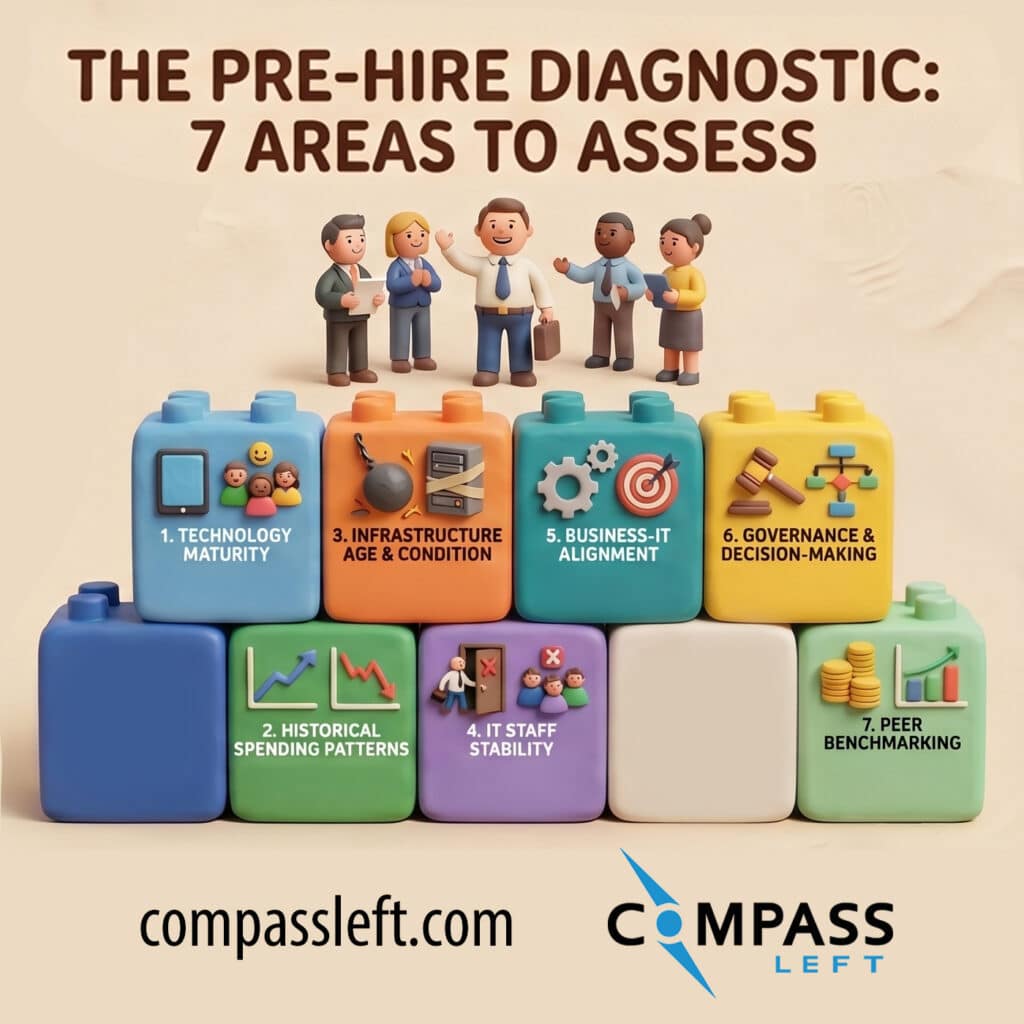
Before you can bring in the right person, you need an honest picture of where your organization actually stands. That means assessing seven critical areas using our proprietary tool:
The Compass Left Pre-Hire Technology Leadership Diagnostic
- Technology Maturity. What is your organization’s real relationship with technology today? Are your employees generally capable and comfortable with the tools they use, or are you struggling with adoption at every level? The answer may look very different depending on the complexity of the organization’s technology footprint. Your hiring strategy needs to reflect that reality.
- Historical Spending Patterns. Pull up your IT spending over the last five to seven years. Is it consistent and deliberate, or does it spike and crash? A steady investment line suggests strategic thinking. A pattern of long dry spells followed by sudden spending suggests a more reactive approach to technology, and that context will define what any new hire walks into.
- Infrastructure Age and Condition. What technical debt are you carrying? An executive walking into a modern, well-maintained infrastructure faces a fundamentally different job than one inheriting a tangle of legacy systems held together with workarounds.
- IT Staff Stability. High turnover in your IT department is a warning signal that goes beyond HR. It usually points to deeper cultural or management problems that will undermine any new leadership hire before they have a chance to succeed.
- Business-IT Alignment. Can you clearly articulate what your technology investments are supposed to achieve? Does the IT team understand the business goals they’re supporting? Does the business leadership understand what IT can realistically deliver? Misalignment here is one of the most common and costly sources of executive failure.
- Governance and Decision-Making. Who has authority over technology purchases and investments? Is the process clear and accountable, or is it political and ad hoc? Without sound governance, even the best executive will struggle to drive consistent results.
- Benchmarking Against Your Peers. This is perhaps the most underutilized diagnostic tool available. If companies similar to yours in industry and size are spending $120 per employee per month on IT support and you’re spending $50, that gap tells you something important. Without knowing what “normal” and “good” look like in your specific context, you have no way to judge whether you’re adequately resourced, dangerously underfunded, or throwing money at the wrong things.
What Our Diagnostic Actually Gives You
Going through this diagnostic process isn’t just due diligence. It produces something genuinely valuable: a baseline.
That baseline tells you what you’re actually dealing with, not what you hope is true, not what sounds good in a board presentation, but the real state of your technology organization. And from that honest starting point, you can make a much clearer determination about what kind of leader you actually need, what mandate is realistic to give them, and what support structure they’ll require to succeed.
Without that clarity, you’re not really hiring strategically. You’re guessing. And the odds, as the research shows, are not in your favor. The organizations that break the cycle of failed IT executive hires aren’t necessarily better at recruiting. They’re better at understanding themselves first.
The Failed IT Executive
Before you hire your next IT executive, complete a pre-hire technology leadership diagnostic. This is what we do at Compass Left.
And if you are considering a CIO, IT director, ERP leader, or major technology hire, Compass Left can help you assess what kind of leader you actually need before you spend the money.

Compass Left
We are dedicated to providing expert business technology management services and offer unparalleled independence. Our focus is to understand your business, apply our knowledge, experience and relationships to ensure the most efficient alignment between technology and your business objectives. Offering executive-level expertise, we engage across all business dimensions, from HR to finance and operations, to ensure technology serves as a backbone for your strategic objectives.