
COMPASS POINT | SOUTH | PART 1 OF 4
Sinking Money
Your money is heading south, silently. Why software waste at a company with moving parts never looks like waste.
SEPTEMBER 2026 · COMPASSLEFT.COM
N E S W
Every business has a bearing.
Do you know yours?
EXPLORE THE SERIES
The Compass
Technology doesn't fail because the software is bad
It fails because nobody is holding the compass.
A software company lives inside its tools, so it staffs people to watch them. A company with real moving parts, trucks, warehouses, crews, production lines, bolts tools onto a physical business. Technology is a supporting actor, so it often gets managed like the phone bill. Then, one reasonable purchase at a time, it becomes the thing your margin, your customer experience, and your key people all depend on. Nobody decided that, and nobody was assigned to notice.
The damage shows up in four recognizable ways. We map them to the four points of a compass.
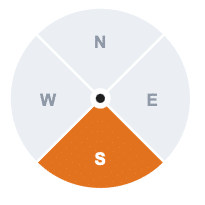
None of the four is a technology problem. All four are ownership problems, and every one is fixable without buying anything.
Compass Points is a series of four, one for each direction. Part one is South. North, East, and West follow. They all come out of the same instrument, the Compass Score, a twelve-statement self-assessment that takes three minutes and gives you a bearing out of 100.
This Compass Point is about money.
What follows is the pattern, one composite company where it played out, and the four habits that stop it.
What changed
Software stopped being a purchase
Here is a number you know to the dollar: what you pay your best driver, your best machinist, your best foreman. Here is one you probably do not know: what you paid for software last month. Not the budget number, the real one, every seat, module, renewal, and per-user fee that hit your cards across every department.
The way companies buy software has changed, and if it has not changed at your company yet, it will.
Capex
On your own servers
You bought it once, and someone approved that purchase.
IT controlled what got bought.
A departure cost you nothing.
Opex
In the cloud
It renews itself, and nobody approves anything.
Any department can buy it with a card.
Every seat you forget bills every month.
Executives are split on whether that trade was worth it. Plenty of them look at a subscription that never ends and conclude they were better off owning. That argument is worth having, and it is not this one. What is not in dispute is the side effect: software spending moved from a decision you approve to a default you inherit, and nothing in the business got reassigned to watch it. If you are mid-migration, you are paying for both right now.
36% Organizations leave an average of 36% of their software licenses unused, measured against recommended utilization levels. If more than a third of your trucks sat idle in the yard, there would be a meeting about it by Friday. (Source: Zylo, 2026 SaaS Management Index.)
The Pattern
Nobody approves a line item called waste
Nobody approves waste. It arrives as ordinary purchases, and then it stays.
How it gets bought
The deal you had to win
A big customer needed labeling, or EDI, or a portal. The deal was worth more than the software, so you bought it that quarter.
The tool that solved one problem
One branch, one crew, one bottleneck. It worked, which is exactly why nobody questioned it. It does nothing else.
The choice someone else made
An insurer, an auditor, or your biggest customer made it a condition. Or a new manager brought a favorite tool from their last job. Nobody asked what it should do for the rest of the business.
—— Then nobody goes back ——
How it survives
Zombie licenses
Adding a seat is urgent on day one. Removing one is urgent to no one. The $89 dispatch seat just keeps billing.
Two systems, one job
Nobody chose to pay twice. The overlap arrived one reasonable purchase at a time.
Contracts that renew themselves
The notice goes to an inbox nobody reads. The vendor is betting you are too busy.
Every one of these was the right call on the day it was made. The waste starts the day after, when the reason it was bought stops being true and no one goes back to check. Sinking money is not a discipline problem, it is what happens when spending is designed to be forgettable and nobody’s job is to remember it.
From the corner office
More seats than people
The company is invented. The problems are not.
A $40M building products distributor. 85 employees, second generation owner, good margins, clean books, a controller who has been there 15 years. Nobody would call this company sloppy. A system inventory turned up three things worth showing you.
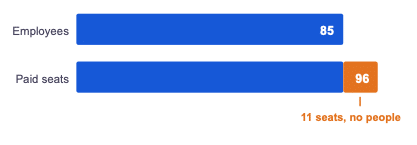
One of the eleven had been gone almost three years. His seat had outlasted two of his replacements.
Three tools were also quoting the same job: the estimating module in the ERP, a standalone app one branch adopted, and, on the biggest accounts, a spreadsheet, because the salesman who handled them trusted neither system.
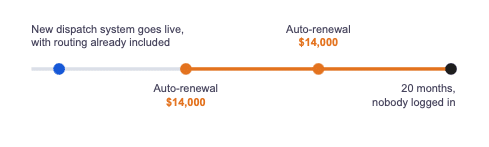
The renewal notices went to a former operations manager’s dead email address.
What the controller sees
Invoices. What each system costs, which department it hit, when it renews.
WASTE
LIVES HERE
What operations sees
Usage. Who logs in, which screens get touched, what nobody has opened in a year.
An invoice tells you what a system costs, not whether anyone uses it. The people who know the usage rarely see the invoices.
The two items above with price tags come to about $26,000. We also found sixteen more, mostly duplicate tools and seats nobody used, which took the total to low six figures a year, for a few days of asking basic questions. Nothing was negotiated and no vendor was squeezed. It was money the business had already decided it did not need, without anyone ever making that decision.
What good looks like
Four habits, none of them technical
You do not need software to manage your software. You need four habits, and none of them takes longer than an afternoon to set up.
1 A one-page inventoryEvery system, what it costs, the business result it exists to produce, and who owns it. A line you cannot fill in is a finding, not a formatting problem.
2 A renewal calendarEvery renewal date, 60 days ahead of it, in front of someone with the authority to cancel. Auto-renewal stops being a trap the moment someone is looking.
3 Offboarding that includes licensesThe same checklist that collects the truck keys and kills the email collects the seats. Day one, not eventually.
4 One job, one right answerTwo systems doing the same job can be a deliberate choice. Two systems with no agreement on which one is right is not, and that is how the wrong number reaches a customer.
A company that does these four things does not have a software waste problem. It is that direct.
What to expect from the Compass Score
1 · 2 · 3 · 4 · 5
1 · 2 · 3 · 4 · 5
Twelve statements like these, rated 1 to 5. Three minutes gets you a score out of 100 and the direction costing you the most. The link is on the next page.
The Compass Score
Your bearing
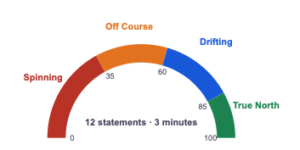
Your ratings convert to a 0-100 score. One benchmark, and it is one we can defend: a well-run company scores 85 or better. That is the rubric’s own math, not survey flattery. Rating yourself all 4s lands you at 75, still Drifting.
The most useful output is not the total, it is your weakest direction. If yours is South, you already know the first two moves, because they are on the page before this one.
Get your bearing in 3 minutes
No gate, no email, no follow-up. Your score is yours alone. If it shows you something you’d like help with, that’s an invitation, not a toll.
Already have your score?
If it showed you something worth a conversation, the button below puts 20 minutes directly on our founder’s calendar. Not a sales call, Compass Left has nothing to sell you but clarity.
Rather ask questions than read?
This brief covers one direction. On Thursday 17 September, Joe Infante walks through this topic, live, in thirty minutes, then stays on for questions about your own operation.
Thursday 17 September · 11:30am ET · Free
Recording sent to everyone who registers, whether you make it or not.
About
Compass Left
Compass Left provides outsourced technology leadership to growing companies with physical operations. We don’t sell software, resell licenses, or take referral fees, so the only thing we have to gain from your assessment is an accurate one.
The Compass Score™ is a self-assessment; results are directional (pun intended). The client story is a composite. © 2026 Compass Left.